The CLARITY Act’s Stablecoin Yield Line Is Now a Wallet-Risk Story
Senate Banking’s May 12 CLARITY Act text does more than revive a crypto market-structure bill. Its stablecoin yield, DeFi, temporary-hold, and tokenization language shows how wallet-risk decisions are moving closer to formal financial controls.

Check a wallet before you act
Run a FreezeRadar scan for issuer-freeze signals, sanctions exposure, counterparty risk, and freezeable asset sensitivity before moving funds.
What happened on May 12
Senate Banking Committee Chair Tim Scott, Digital Assets Subcommittee Chair Cynthia Lummis, and Senator Thom Tillis released market-structure bill text on May 12, 2026. The committee said the text would serve as the basis for the May 14 markup and reflected negotiations with lawmakers, regulators, law enforcement, financial institutions, innovators, and consumer advocates.
The official materials matter for two reasons.
First, the updated bill is no longer just an abstract crypto jurisdiction document. The table of contents alone shows the breadth of the package: responsible securities innovation, illicit finance, DeFi, banking innovation, regulatory sandboxes, software developer protections, customer property, and customer protection.
Second, the section-by-section summary makes clear that the committee is trying to insert compliance and risk-management concepts directly into the market structure. Digital commodity brokers, dealers, and exchanges would be treated as financial institutions for Bank Secrecy Act purposes. Treasury would set risk-based examination standards for digital asset AML and terrorism-finance obligations. DeFi-adjacent activity would be split between core infrastructure, front ends, non-decentralized protocols, and intermediaries that route activity through DeFi.
The draft’s “clarity” is less about assigning regulators and more about naming control points.
The stablecoin yield compromise is the headline
The most politically important change is Section 404, titled “Prohibiting Interest and Yield on Payment Stablecoins.” The May text does not ban every reward connected to stablecoin use. Instead, it draws a line between passive, deposit-like yield and activity-based or transaction-based rewards.
That line is the product of months of argument. Banks and banking advocates have worried that yield-bearing stablecoins could mimic bank deposits without the same prudential rules, potentially pulling funding away from banks. Crypto firms have argued that rewards tied to payments, settlement, liquidity provision, market-making, staking, governance, loyalty programs, or other active uses are not the same as interest paid on a deposit.
The May text lands in the middle. Covered digital asset service providers and their affiliates would be prohibited from paying U.S. customers interest or yield “solely” for holding payment stablecoins, or on a stablecoin balance in a way that is economically or functionally equivalent to bank deposit interest. The text still preserves room for bona fide activity-based rewards, including payments, transfers, conversions, remittances, settlement activity, market-making liquidity, collateral posting, governance, validation, staking, and product or service use.
One nuance matters for product design. Rewards may be calculated by reference to balance, duration, tenure, or a combination of those factors if the underlying program fits the permitted activity framework and is not effectively deposit interest. That gives platforms room to keep some balance-aware incentive programs, but it also means they will need to document why the reward is tied to real activity rather than passive holding.
For wallet and treasury teams, the practical message is simple: “stablecoin yield” is becoming a product-design and compliance-classification problem, beyond a marketing feature.
Why this matters for wallet monitoring
The stablecoin yield debate sits closer to wallet screening than it first appears.
When a stablecoin product is framed as payment infrastructure rather than a synthetic savings account, flows matter more. The activity behind the balance matters more. The reason a user is receiving compensation matters more. And the platform’s ability to explain a wallet’s role in payments, settlement, market-making, collateral, loyalty, or DeFi activity becomes part of the risk picture.
That pushes teams toward more granular wallet policy.
A treasury wallet that only receives customer settlement flows is different from a wallet used for liquidity provision. A wallet that collects platform rewards is different from a wallet used as a cold reserve. A wallet that routes through DeFi front ends is different from a wallet that only receives regulated exchange withdrawals. If regulation starts distinguishing activity-based stablecoin rewards from passive stablecoin balance yield, internal wallet records need to preserve those distinctions too.
This is where many operations teams are still underbuilt. They may know which address belongs to the company, but not what operational purpose the address serves, which counterparties are approved for it, what assets are expected there, which reward programs touch it, which routes are allowed, or what exposure threshold triggers review.
That weakness becomes harder to defend under a more formal stablecoin regime.
Temporary holds are an intervention signal
The section-by-section summary also describes a temporary-hold safe harbor for permitted payment stablecoin issuers and digital asset service providers. In plain terms, the bill would let firms voluntarily place short holds on suspicious digital asset transactions, including where law enforcement has made a written request, if they act in good faith and follow notice and recordkeeping conditions.
This is not the same as saying every issuer or platform must hold every suspicious transaction. The summary says the provision clarifies that firms are not required to impose holds and that existing suspicious activity reports, seizure, and sanctions authorities remain in force.
The existence of a temporary-hold framework still matters for ops. It recognizes that intervention can happen before permanent freezes or formal sanctions designations. Some of the most consequential operational risk happens in the gray zone before final disposition: a platform pauses, asks questions, requests documentation, escalates to law enforcement, or waits for a counterparty to explain the source and purpose of funds.
For stablecoin users, that means the monitoring question cannot stop at “will this address be blacklisted?” A better question is: “Would this flow create enough concern for an issuer, exchange, custodian, or payment platform to delay or review it?”
That is the operational zone where wallet intelligence matters most.
The DeFi provisions point to route quality alongside address quality
The new CLARITY Act text also spends substantial drafting energy on DeFi. Related analyses from Galaxy and Digital Watch both highlight the bill’s attempt to distinguish core infrastructure from controlled, non-decentralized activity. The section-by-section summary excludes protocols, nodes, wallets, and other core infrastructure from the definition of a distributed ledger messaging system, while directing Treasury to publish sanctions and AML/CFT guidance for U.S.-person-owned or operated web-hosted front ends.
It also requires risk management standards for digital asset intermediaries before routing or conducting trading activity through a DeFi trading protocol. Those programs would need to analyze money laundering, sanctions evasion, fraud, market manipulation, operational risk, cyber risk, and the use of tools such as blockchain analytics.
This distinction is useful. It avoids pretending that every validator, node operator, wallet, or protocol component is the same kind of compliance actor. It also makes clear that intermediaries cannot treat DeFi routing as a context-free black box.
For FreezeRadar’s purposes, that is a familiar point. DeFi indirect exposure covers more than whether a token touched a smart contract. It also asks whether the route obscured, concentrated, amplified, or transferred risk in a way that affects the receiving wallet. If a platform routes stablecoin liquidity through a protocol or front end with weak controls, sanctions exposure or high-risk counterparty exposure can become a treasury problem even if the final inbound transfer looks clean in isolation.
That is why wallet monitoring needs route context. A balance is not self-explanatory.
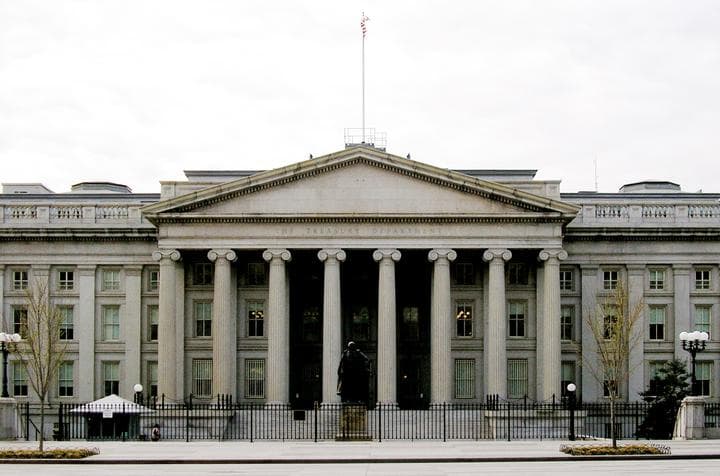
Image credit: Wikimedia Commons / USCapitol and Architect of the Capitol, public domain as U.S. federal government work.
Offshore stablecoins and tokenized securities enter the risk map
Two other parts of the May text deserve attention.
The offshore stablecoin report would require Treasury to assess whether offshore stablecoins that rely on U.S. Treasuries and are used at scale pose material illicit-finance threats or vulnerabilities. That matters because the stablecoin market is not a question of domestic issuers alone. A dollar-referenced token can depend heavily on U.S. financial markets, circulate globally, and still sit outside the most direct U.S. supervisory perimeter.
For treasury teams, offshore stablecoin risk should not be reduced to “is the token liquid?” The better questions are: who can freeze or restrict it, where are the reserves, what compliance commitments does the issuer make, how does it handle law-enforcement requests, and how would an exchange or bank treat large inbound flows from that asset under pressure?
The tokenization language is also relevant. The May section-by-section summary states that tokenized securities remain securities for regulatory purposes and that the SEC should study custody, interagency coordination, cross-border coordination, and consumer protection. That is a reminder that tokenization does not erase the nature of the underlying instrument. A tokenized security may move on a blockchain, but it still carries issuer, custodian, transfer-agent, sanctions, and market-integrity assumptions.
This is where freezeable-asset thinking becomes useful beyond USDT and USDC. The more real-world assets move onchain, the more teams need to distinguish bearer-like crypto exposure from issuer-controlled or administrator-controlled asset exposure.
What teams should do now
The CLARITY Act is not final, and teams should not treat draft legislation as binding law. But they should treat the May 12 text as a useful map of the operating questions regulators are likely to keep asking.
Start with wallet purpose. Every institutional stablecoin wallet should have a documented role, the same discipline we describe in FreezeRadar’s wallet watchlist strategy: customer receipts, exchange transfers, DeFi routing, treasury reserve, market-making collateral, payment settlement, redemption, operational float, or investigation hold. If the wallet’s purpose is unclear, monitoring alerts will be harder to interpret.
Next, separate direct screening from activity classification. A wallet may have no direct sanctions hit and still be unsuitable for a specific workflow if it has poor provenance, opaque DeFi routing, repeated exposure to high-risk counterparties, unexplained reward activity, or DeFi indirect exposure that changes the practical risk.
Third, record why rewards or incentives exist. If a platform pays or receives stablecoin-linked rewards, the team should be able to explain the activity behind the reward and the wallet role involved. “Balance went up” is not enough. Record whether the credit came from settlement, liquidity provision, collateral, a rebate, a loyalty program, or a trading incentive. Those distinctions may matter under the yield line.
Fourth, build an intervention playbook. Decide in advance what triggers a hold, a manual review, a counterparty documentation request, or a routing restriction. The draft bill’s temporary-hold language is a reminder that delay and review are real operational outcomes, even when no permanent freeze follows.
Finally, monitor policy changes as product-risk inputs. Stablecoin policy is not separate from treasury risk. When a bill changes the rules around yield, DeFi routing, offshore stablecoins, or tokenized securities, it changes the assumptions behind wallet operations.
Key takeaway
The May 12 CLARITY Act text is more than a Washington process milestone. It signals that stablecoin market structure is becoming more operationally specific.
The main shift is not that Congress may give crypto “clarity.” The clarity being drafted increasingly depends on wallet purpose, transaction context, intermediary role, stablecoin control design, and documented risk management. That is the world freezeable-asset teams need to prepare for.
If your organization depends on USDT, USDC, tokenized assets, or DeFi-adjacent stablecoin routes, the next control gap to close spans direct sanctions screening and the space between a balance and the activity that produced it.
References
- U.S. Senate Banking Committee, “Chairman Scott, Senators Lummis, Tillis Release Market Structure Bill Text Ahead of Banking Committee Markup,” May 12, 2026.
- U.S. Senate Banking Committee, “Digital Asset Market Clarity Act” revised bill text, May 12, 2026.
- U.S. Senate Banking Committee, “Digital Asset Market Clarity Act Section-by-Section,” May 12, 2026.
- Galaxy Research, “CLARITY Act: Senate Banking Releases New Text, Sets Thursday Markup,” May 12, 2026.
- Baker McKenzie Blockchain Blog, “The CLARITY Act’s Yield Compromise: What the Senate Agreed To, and Why It Matters,” May 5, 2026.
- Digital Watch Observatory, “Stablecoin rules updated in revised US Senate proposal,” May 12, 2026.
Image and source notes
Cover image: Wikimedia Commons file Flickr - USCapitol - Dirksen Senate Office Building (1).jpg, USCapitol / Architect of the Capitol, public domain as a U.S. federal government work.
Inline image: Wikimedia Commons file Dirksen Building Detail (28005664250).jpg, USCapitol / Architect of the Capitol, public domain as a U.S. federal government work.
Related FreezeRadar reading: Treasury Stablecoin Sanctions Framework, Wallet Watchlist Strategy, DeFi Indirect Exposure, and Stablecoin Compliance 101.
Sources (6)
Chairman Scott, Senators Lummis, Tillis Release Market Structure Bill Text Ahead of Banking Committee Markup
U.S. Senate Committee on Banking, Housing, and Urban Affairs
Primary source release dated May 12, 2026.
Digital Asset Market Clarity Act revised bill text
U.S. Senate Committee on Banking, Housing, and Urban Affairs
Revised 309-page bill text released May 12, 2026.
Digital Asset Market Clarity Act section-by-section summary
U.S. Senate Committee on Banking, Housing, and Urban Affairs
Committee summary used for DeFi, temporary-hold, offshore-stablecoin, and tokenization provisions.
CLARITY Act: Senate Banking Releases New Text, Sets Thursday Markup
Galaxy Research
Related market-structure analysis reviewed.
The CLARITY Act’s Yield Compromise: What the Senate Actually Agreed To—and Why It Matters
Baker McKenzie Blockchain Blog
Related legal analysis of the stablecoin yield compromise.
Stablecoin rules updated in revised US Senate proposal
Digital Watch Observatory
Related analysis reviewed for stablecoin rule changes.
Related reading
Continue exploring FreezeRadar knowledge content.


On this page
Get posts like this by email
A daily or weekly digest of FreezeRadar freeze activity.
By FreezeRadar Team
Research and product team behind FreezeRadar.