Shelbit and Aban Tether Show How Sanctions Risk Moves Through Exchange Plumbing
Treasury’s August 7 sanctions against Shelbit and Aban Tether show why wallet-risk teams need to monitor exchange infrastructure, gambling flows, Nobitex exposure, and stablecoin rails before assets become blocked property.
Check a wallet before you act
Run a FreezeRadar scan for issuer-freeze signals, sanctions exposure, counterparty risk, and freezeable asset sensitivity before moving funds.
What OFAC Did
OFAC’s August 7 action blocks property and interests in property of the designated persons that are in the United States or in the possession or control of U.S. persons. It also applies OFAC’s familiar 50 percent rule to entities owned by blocked persons. For U.S. persons, the default position is prohibition unless a license or exemption applies. For non-U.S. firms, the operational risk is broader: a transaction chain that causes a U.S. person to violate sanctions, or that looks like evasion, can become a serious enforcement problem.
The designations focused on two exchange channels.
Shelbit is the more complex of the two. Treasury says Kayvanpour operated a multi-nation company network around Shelbit Exchange. The release describes IRGC-linked wallet flows into and out of Shelbit, transfers to Nobitex, and the laundering of tens of millions of dollars from a large Persian-language gambling network. It also notes that Dubai’s Virtual Assets Regulatory Authority had already taken enforcement action against Shelbit General Trading in January 2025 and July 2026.
Aban Tether is operationally different but just as relevant for monitoring. Treasury says the Iran-based exchange processed millions of dollars of transactions involving sanctioned Iranian exchanges including Nobitex, Wallex, Bitpin, and Ramzinex. That makes the name easy to misunderstand and the risk easy to misclassify. The issue is not issuer control by Tether. The issue is that an exchange with “Tether” in its name can sit inside a sanctions-relevant liquidity route where USDT and other assets may be used as settlement media.
Why This Became a Wallet-Risk Story
A sanctions designation is a legal event. A wallet-risk event is what happens next.
Once a platform, operator, or related address cluster becomes sanctions-relevant, counterparties have to decide how to treat funds that touched the cluster before the designation, after the designation, or through an intermediary that did not look risky at first. The Reuters-linked reporting around Shelbit described a much larger transaction footprint, including flows from Shelbit-linked addresses to major global platforms. Binance told Reuters, according to Iran International’s summary, that Shelbit had never held a Binance account and that associated transactions were later investigated, frozen, and reported to law enforcement.
That distinction matters. A platform can be exposed to flows from an entity without directly onboarding that entity as a customer. On-chain settlement is composable in a way that customer files are not. Funds can arrive through nested services, intermediaries, deposit addresses, gambling rails, brokers, OTC desks, payment processors, bridges, and retail accounts that look ordinary until cluster intelligence catches up.
This is the same reason we treat indirect exposure as a first-class risk signal in FreezeRadar. A wallet does not need to be listed by OFAC to become operationally difficult. If it receives funds from a high-risk exchange cluster, sends funds into a venue that later blocks or reports the activity, or holds freezeable stablecoins that an issuer may immobilize after a law-enforcement request, the risk has already entered the workflow.
That is the practical bridge to our earlier analysis of A7A5 sanctions and indirect stablecoin exposure and OFAC’s Zanjani digital-asset network. The enforcement record is moving away from a narrow “bad wallet” model and toward a network model where addresses, entities, platforms, payment context, and asset control all matter at the same time.
The Stablecoin Angle Extends Beyond USDT Freezing
It is tempting to reduce every Iran-linked crypto sanctions story to one question: did Tether freeze the USDT? That is too narrow.
Stablecoins matter here because they are the operating currency of many crypto liquidity routes. They are useful for moving value across venues, pricing assets, settling gambling or exchange balances, and connecting local currency demand to global dollar liquidity. That utility is exactly why sanctions teams care about them.
Freezeable assets add another layer. If a wallet holds USDT, USDC, PAXG, XAUt, or another centrally controlled asset, the legal and operational consequence of being near a designated network can be different from holding a non-freezeable asset. An issuer may freeze tokens after a valid legal request. A centralized exchange may block deposits or disable withdrawals. A banking partner may reject settlement. A counterparty may refuse to trade. These are different interventions, but from a treasury desk’s point of view they can all create the same problem: assets that are technically visible but operationally unusable.
The Shelbit and Aban Tether action also shows why names and symbols are poor substitutes for entity intelligence. Aban Tether is not Tether, the USDT issuer. But a compliance team that only searches for “Tether” as an issuer-control issue may miss the exchange-risk question. Conversely, a team that only watches official issuer freeze events may miss the earlier exchange-route signal that makes a wallet hard to use long before a token contract blocks transfers.
For a deeper grounding in this distinction, see FreezeRadar’s guides on stablecoin freeze risk and how token freezing works in smart contracts. The key point is that legal blocking, exchange blocking, and token-level freezing are related but not identical controls.
The VARA Signal Came Before OFAC
One underappreciated detail is timing. VARA’s regulatory notices page shows a July 24, 2026 notice of fines against Shelbit General Trading, commercially operating as Shelbit or Shelbit Exchange. The notice followed a January 2025 cease-and-desist and enforcement action. Treasury then cited VARA’s earlier actions in its August 7 release.
That sequence is exactly what monitoring teams should study. Local regulator warnings are not always conclusive sanctions indicators, but they are strong operational context. If a virtual asset business has been fined, warned, ordered to cease unlicensed activity, or flagged for AML/CFT concerns, counterparties should not wait for OFAC or another national authority to make the risk easy.
This is especially true for treasury teams that use exchanges as routing points rather than long-term custodians. The risky moment may be a short settlement hop. A wallet may receive funds from a client, pass them through a venue, convert into a stablecoin, and move onward within minutes. If the route touches a platform already under enforcement pressure, the team may inherit a documentation problem even if the final asset balance looks clean.
A practical monitoring stack should therefore watch more than addresses. It should track entity names, known aliases, trading names, jurisdictional notices, related companies, exchange clusters, deposit patterns, and newly designated counterparties. Those signals should then feed wallet scoring, transaction review, and escalation rules.
What Teams Should Do Now
The immediate operational response is not panic. It is hygiene.
First, rescreen wallets and recent counterparties against the August 7 designations. That includes direct exposure to named entities and any wallet clusters identified by intelligence providers as related to Shelbit, Aban Tether, Kayvanpour, Nobitex, Wallex, Bitpin, Ramzinex, or connected Iranian exchange routes. Direct OFAC matches need legal handling. Indirect matches need documented review, risk grading, and a clear decision trail.
Second, check recent stablecoin flows. The question covers more than whether a wallet is frozen today. It is whether it has received stablecoins from a route that may become blocked, rejected, or frozen later. Stablecoin balances tied to unclear source-of-funds can create treasury friction when they are moved into exchanges, converted into fiat, sent to vendors, or used as collateral.
Third, revisit exchange allowlists. A platform can be licensed in one jurisdiction, warned in another, unlicensed in a third, and still connected to global liquidity. Teams should treat regulator notices as monitoring inputs, beyond legal trivia. VARA’s Shelbit action before the OFAC designation is the kind of early signal that should feed counterparty review.
Fourth, separate issuer-freeze risk from exchange-intervention risk. If a wallet holds USDT, issuer action is one possible control point. If funds are routed through a centralized exchange, account freezing or reporting is another. If the funds touch a banked off-ramp, correspondent banking controls become a third. A useful wallet-risk view should show all three instead of collapsing them into a single “sanctions” label.
Finally, keep a before-and-after view. Exposure before August 7, 2026 does not have the same posture as exposure after designation, but neither should be ignored. Historical exposure can affect enhanced due diligence, source-of-funds review, and exchange questioning. Post-designation exposure can trigger a much sharper escalation.
Key Takeaway
The Shelbit and Aban Tether designations are important because they connect the legal sanctions list to the messy infrastructure of crypto settlement. Treasury did not describe a single rogue wallet. It described a network: exchange operators, related companies, gambling flows, Iranian financial institutions, sanctioned exchanges, and digital-asset routes that can touch global venues.
That is where wallet monitoring has to go. The next serious freeze, block, or seizure event may not start with an address you already know. It may start with an exchange name in a regulator notice, a cluster that receives funds from a gambling network, or a stablecoin route that looks liquid until a compliance desk asks where the money came from.
For teams holding or accepting freezeable assets, the lesson is direct: monitor the route, beyond the balance.
Sources and Image Credits
- U.S. Department of the Treasury, “Treasury Sanctions Crypto Exchanges Funding Iran’s IRGC and Enabling Illicit Finance,” August 7, 2026.
- Dubai Virtual Assets Regulatory Authority, “VARA Notice of Fines – Shelbit General Trading L.L.C,” July 24, 2026.
- CoinDesk, “U.S. Widens Iran Crypto Crackdown With Sanctions on Two Exchanges,” August 7, 2026.
- FinanceFeeds, “Shelbit and Aban Tether Sanctioned Over Alleged Iran Finance Links,” August 8, 2026.
- Iran International summary of Reuters reporting, “Iran gambling network helped channel $4 billion through crypto exchange,” July 31, 2026.
- Incrypted, “Dubai-based Crypto Exchange Shelbit Got US sanctions for Helping Iran with Millions of Dollars,” August 8, 2026.
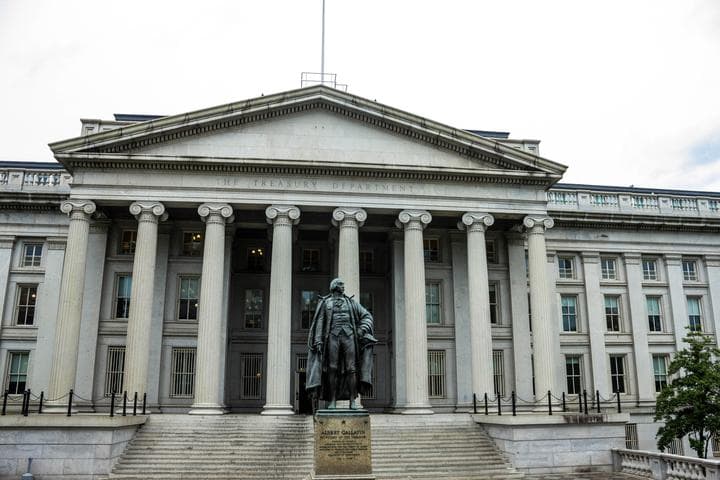
- Cover image: U.S. Treasury Department photo, “Treasury Building (32648233951).jpg,” Wikimedia Commons, public domain as U.S. Treasury work.
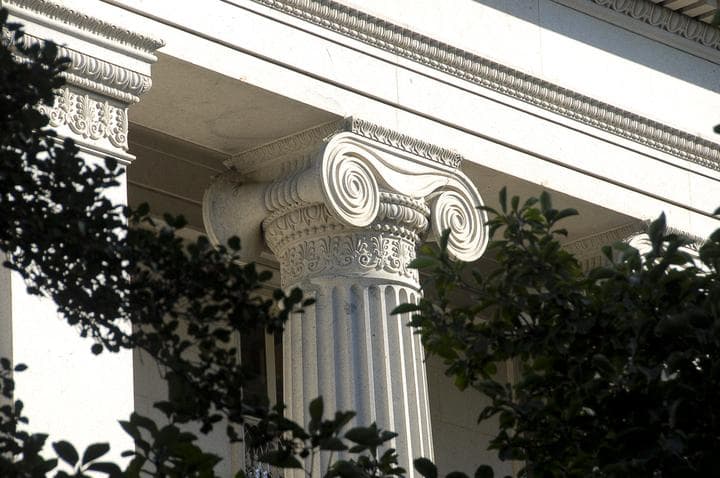
- Inline image: “Dubai Financial Centre (14467461845).jpg,” Wikimedia Commons, Creative Commons Attribution 2.0 Generic.
References
- Treasury Sanctions Crypto Exchanges Funding Iran’s IRGC and Enabling Illicit Finance
- Licensing and Enforcement Notices: VARA Notice of Fines – Shelbit General Trading L.L.C
- U.S. Widens Iran Crypto Crackdown With Sanctions on Two Exchanges
- Shelbit and Aban Tether Sanctioned Over Alleged Iran Finance Links
- Iran gambling network helped channel $4 billion through crypto exchange - Reuters
- Dubai-based Crypto Exchange Shelbit Got US sanctions for Helping Iran with Millions of Dollars
Sources (6)
Treasury Sanctions Crypto Exchanges Funding Iran’s IRGC and Enabling Illicit Finance
U.S. Department of the Treasury
Primary OFAC/Treasury release dated August 7, 2026.
Licensing and Enforcement Notices: VARA Notice of Fines – Shelbit General Trading L.L.C
Dubai Virtual Assets Regulatory Authority
Primary Dubai regulator notice dated July 24, 2026.
U.S. Widens Iran Crypto Crackdown With Sanctions on Two Exchanges
CoinDesk
Related coverage reviewed for market and policy framing.
Shelbit and Aban Tether Sanctioned Over Alleged Iran Finance Links
FinanceFeeds
Related coverage dated August 8, 2026.
Iran gambling network helped channel $4 billion through crypto exchange - Reuters
Iran International / Reuters
Reuters-based investigation summary reviewed for Shelbit network context.
Dubai-based Crypto Exchange Shelbit Got US sanctions for Helping Iran with Millions of Dollars
Incrypted
Related explainer dated August 8, 2026.
Related reading
Continue exploring FreezeRadar knowledge content.


On this page
Get posts like this by email
A daily or weekly digest of FreezeRadar freeze activity.
By FreezeRadar Team
Wallet risk intelligence and stablecoin compliance analysis from FreezeRadar.