A7A5 Shows How Sanctions Can Break a Stablecoin Without Freezing Every Wallet
Fresh A7A5 coverage shows the practical effect of coordinated sanctions: not every token needs to be frozen if exchanges, issuers, and counterparties learn to reject the exposure.

A sanctioned stablecoin does not have to stop moving on-chain to become operationally toxic. That is the lesson from the renewed coverage of A7A5, the ruble-linked stablecoin connected to Russia-focused sanctions-evasion infrastructure. The token still exists. Smart contracts can still process transfers. Some activity can continue in pockets of the market. But the important point for compliance, treasury, and wallet-risk teams is sharper: once a stablecoin becomes a recognized sanctions vector, its usefulness can collapse because the exits, counterparties, liquidity venues, and adjacent USDT paths begin to reject it.
That is why the latest A7A5 coverage matters for FreezeRadar readers. Crowdfund Insider republished Elliptic's analysis on August 2, 2026, and Elliptic followed with an August 4 regulatory update on the EU's latest Russia sanctions package. The underlying government action is not brand new: the Council of the European Union adopted its 21st Russia sanctions package on July 23, 2026, and earlier U.S., UK, and EU actions had already targeted parts of the A7 ecosystem. Still, the current operational story is worth separating from the legal date. A7A5 is now a live case study in how a token built to route around freezeable Western stablecoins can itself become a visible risk marker.
For teams that accept, hold, route, or monitor stablecoins, the lesson is not simply "avoid A7A5." The lesson is that indirect exposure can become a business problem before an address appears as a direct sanctions hit, and before an issuer freeze occurs. That is exactly the zone where wallet intelligence has to be better than checkbox screening.
Check a wallet before you act
Run a FreezeRadar scan for issuer-freeze signals, sanctions exposure, counterparty risk, and freezeable asset sensitivity before moving funds.
What Happened
A7A5 emerged as a ruble-backed stablecoin tied to Russia-linked financial infrastructure and the A7 network. The attraction was obvious for sanctions-sensitive users: unlike USDT or USDC, A7A5 was not controlled by a Western issuer that could be compelled to freeze balances on request from U.S. or European authorities. In that design, the token's value proposition was not only speed or settlement convenience. It was a control-plane arbitrage.
Elliptic's recent analysis frames the unwind clearly. A7A5 had been used to support large volumes of Russia-linked stablecoin activity, including routes into and out of USDT liquidity. But as sanctions pressure expanded to the surrounding ecosystem, the token's practical liquidity weakened. Exchanges and counterparties became more cautious. Users reportedly warned each other that touching A7A5-related venues or wallets could trigger account closures or frozen receipts at mainstream platforms. In other words, the token's on-chain transferability remained less important than its off-chain acceptability.
The EU's July 23 package reinforces that point. The Council described new Russia-related measures that hit energy, financial services, and crypto hard. Related legal and blockchain-intelligence commentary has focused on the package's expansion of crypto-asset restrictions, including measures around services and platforms used by Russia. Elliptic's August 4 regulatory update specifically linked the new package to the broader A7 network and the A7A5 stablecoin context.
For a wallet-risk team, the date mechanics matter. The freshest public coverage came on August 2 and August 4, 2026. The official EU action was July 23, 2026, outside the strict 72-hour window. That makes this a fallback story under the automation rules, but not a weak one. It is the strongest currently relevant story because it connects sanctions design, stablecoin issuer control, exchange intervention, and indirect wallet exposure in one concrete example.
The Real Story Is Not the Token. It Is the Exit Layer
A stablecoin is only useful if someone credible accepts it at par or near par. That sounds basic, but it is often missed in crypto risk discussions that focus only on contract-level freezing. A7A5 shows the other half of the control system.
Freezeable dollar stablecoins such as USDT and USDC have issuer-level intervention points. An issuer can block an address, freeze balances, or cooperate with law enforcement when a competent authority provides a request. That creates obvious custody and transfer risk for sanctioned or stolen funds. A token like A7A5 tries to reduce that specific risk by moving outside the Western issuer-control layer.
But the strategy creates a new dependency. If the token needs conversion into USDT, fiat, or exchange balances to be useful, then the exit layer becomes the enforcement surface. A7A5 did not need every holder wallet to be frozen for its utility to deteriorate. It needed liquidity providers, exchanges, counterparties, and stablecoin issuers to treat A7A5 adjacency as a problem.
That is a different kind of intervention risk. It is not always visible as a direct blacklist entry. It appears as failed deposits, manual reviews, account closures, blocked withdrawals, higher friction at OTC desks, and counterparties refusing to touch funds with a contaminated path. This is why two-hop exposure analysis and DeFi indirect exposure are not academic ideas. In a case like A7A5, the risk spreads through routing.
Why Indirect Exposure Became the Decisive Signal
Direct sanctions screening asks whether the exact address is named, controlled by a named person, or part of a known blocked-property set. That is necessary, but it is not enough when a stablecoin ecosystem is being used as a sanctions-evasion bridge.
A7A5's practical problem appears to be adjacency. If a wallet swapped A7A5 into USDT, received USDT from an A7A5-linked liquidity venue, or interacted with exchanges that supported the network, the wallet could inherit a risk signal even without being named in an official sanctions list. That does not mean every adjacent wallet is guilty of anything. It means counterparties may treat the history as operationally unacceptable until the wallet owner can explain the source of funds.
The same pattern is familiar from mixer exposure, exploit laundering, high-risk exchange clusters, and sanctioned service infrastructure. The more important the counterparty, the less tolerance it has for ambiguous provenance. A global exchange does not need to prove criminal intent to freeze an account for review. A stablecoin issuer does not need to wait for a public press release before escalating a high-confidence law-enforcement request. A treasury team does not need to accept a payment simply because the sender's current address is not on a list.
This is where A7A5 intersects directly with FreezeRadar's operating model. Our focus is not to declare final guilt from a single hop. It is to identify evidence-backed wallet risk: direct sanctions exposure, risky counterparties, issuer-freeze sensitivity, and behavior that can turn a balance into a review problem. A7A5 is a reminder that the exposure graph can matter as much as the token symbol.
The USDT Bridge Is the Telltale Detail
One reason A7A5 is so relevant is that it was not isolated from dollar stablecoin rails. Elliptic's earlier research described A7A5's role alongside USDT liquidity and Russia-linked exchange infrastructure. That bridge is the key operational point.
A ruble-backed token can be politically and commercially useful inside a closed network, but cross-border value still often wants dollar liquidity. If users need to convert into USDT to pay suppliers, settle with offshore intermediaries, or reach deeper liquidity, then USDT becomes the pressure point. Tether's freeze authority and exchange screening standards can make the route fragile even when the ruble token itself remains transferable.
This is the same lesson visible in prior USDT intervention cases. When Tether freezes balances connected to sanctions or illicit finance, the market tends to focus on the frozen dollar amount. The larger lesson is the intervention window: how quickly funds moved, which venues touched them, whether swaps created downstream recipients, and which wallets inherited risk before the freeze. We covered that dynamic in Tether, OFAC, and the $344 million USDT freeze. A7A5 adds the inverse case: a non-Western stablecoin can become toxic precisely because it still needs Western-controlled or Western-facing rails.
What Treasury and Compliance Teams Should Change
The practical response is not to ban every wallet that ever touched a risky ecosystem. That would create false positives and bad customer outcomes. The practical response is to make exposure handling more granular.
First, teams should distinguish direct sanctions hits from indirect exposure. A direct SDN-linked address, issuer blacklist hit, or named exchange cluster should trigger a different workflow than a remote historical interaction with a high-risk venue. Both matter, but they should not be treated as identical.
Second, teams should monitor conversion points. Stablecoin risk often crystallizes when funds move from one control environment to another: A7A5 to USDT, high-risk exchange to major exchange, DEX pool to centralized deposit, bridge to issuer-controlled chain. The conversion point is where a compliance team can still ask questions before funds become treasury inventory.
Third, teams should track issuer-control sensitivity by asset. USDT, USDC, PAXG, and XAUt do not behave like Bitcoin. Their issuers or controlling contracts can respond to legal process and blacklist evidence. That can protect victims and support sanctions enforcement, but it also changes settlement finality. A treasury team holding freezeable assets needs to know not just whether a payment settled, but whether it could become restricted after settlement.
Fourth, teams should maintain documentation for legitimate flows. If a business receives funds from a counterparty that happens to be near a risky cluster, the ability to show invoices, contracts, exchange records, and source-of-funds context can matter. Monitoring without documentation becomes a dashboard. Monitoring with evidence becomes an escalation process.
Finally, teams should avoid assuming that decentralized routing removes counterparty risk. DeFi paths can obscure intent, but they do not erase provenance. In fact, when regulators and analytics firms focus on a named network, DeFi interactions may become easier to cluster and harder to explain. That is why wallet monitoring strategy should include alert review, not just automated pass/fail labels.
What to Watch Next
The next signal is not whether A7A5 disappears completely. It probably will not. Tokens can keep moving in smaller pools, controlled channels, or jurisdictions with weaker enforcement. The better signal is whether A7A5-linked liquidity can regain credible exits into major stablecoins, mainstream exchanges, and trade-settlement venues.
Watch for three things. The first is new EU, UK, or U.S. designations against service providers rather than the token itself. That would show continued pressure on the distribution layer. The second is exchange behavior: delistings, deposit warnings, blocked withdrawals, or public compliance notices. The third is user migration. If the same actors shift from A7A5 into new ruble, gold, or commodity-linked tokens, the wallet-risk problem moves rather than ends.
For stablecoin issuers, the A7A5 episode also strengthens the case for secondary-market monitoring. Issuers are no longer judged only on whether they maintain reserves and redeem tokens. They are increasingly judged on whether they can identify and act on illicit use outside the primary issuance channel. That is the policy direction behind stablecoin AML and sanctions proposals, and it is the operational reality behind issuer freezes.
Key Takeaway
A7A5 shows that sanctions can break a stablecoin at the edges. The contract can keep running, the token can keep transferring, and some users can keep trying to route around restrictions. But if the market learns that touching the token creates unacceptable counterparty risk, the stablecoin loses the thing it needed most: trusted exits.
For FreezeRadar readers, that is the useful lesson. Wallet risk is not only about the asset in the wallet. It is about who controlled the asset, where it came from, what it touched, which issuer can intervene, and which counterparty will still accept it tomorrow. A7A5 is not just a Russia sanctions story. It is a working example of why indirect exposure, issuer control, and monitoring discipline now sit at the center of stablecoin operations.
Image Credits
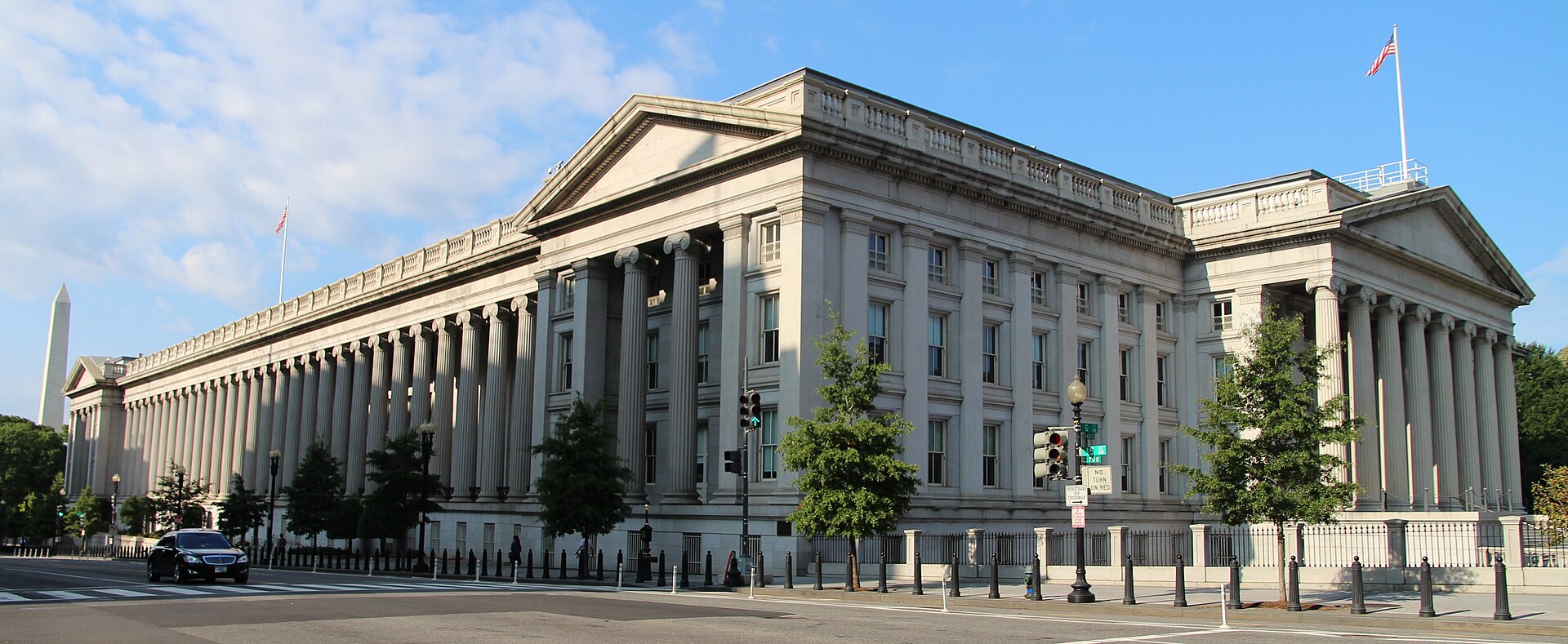
Cover image: Europa building in Brussels by FrDr, Wikimedia Commons, Creative Commons Attribution-Share Alike 4.0 International. Inline image: United States Treasury Building by AgnosticPreachersKid, Wikimedia Commons, Creative Commons Attribution-Share Alike 3.0 Unported.
Sources (8)
Crypto regulatory affairs: EU adopts new Russia sanctions
Elliptic
August 4, 2026 regulatory update connecting the EU package to A7/A7A5 sanctions-evasion infrastructure.
Blockchain Intelligence Firm Elliptic Examines How Sanctions Strangled Russian Ruble based Stablecoin A7A5
Crowdfund Insider
August 2, 2026 related coverage of Elliptic analysis; used as the within-72-hours news hook.
The fall of A7A5: how sanctions strangled the ruble stablecoin
Elliptic
Primary blockchain-intelligence analysis of A7A5 liquidity, sanctions pressure, and USDT adjacency.
21st package of sanctions: EU hits Russian energy, financial services and crypto hard
Council of the European Union
Official July 23, 2026 primary source for the EU sanctions package.
EU's 21st Package Extends Crypto Sanctions to Third Countries
TRM Labs
Related blockchain-intelligence analysis of the EU package and crypto-service restrictions.
The EU 21st Russian Sanctions Package Is Here: Business Implications
Cooley
August 4, 2026 legal analysis of the package, including crypto-asset measures.
Europa building European Union Brussels 01
Wikimedia Commons
Cover image credit: FrDr, CC BY-SA 4.0.
United States Treasury Building.JPG
Wikimedia Commons
Inline image credit: AgnosticPreachersKid, CC BY-SA 3.0.
Related reading
Continue exploring FreezeRadar knowledge content.


On this page
Get posts like this by email
A daily or weekly digest of FreezeRadar freeze activity.
By FreezeRadar Team
Wallet risk intelligence and stablecoin compliance analysis from FreezeRadar.