Stablecoin Reporting Is Becoming Wallet-Risk Infrastructure
CSBS's August 11 comment letter on OCC stablecoin reporting forms shows why issuer data, redemption controls, and supervision details now matter to wallet-risk teams.
Check a wallet before you act
Run a FreezeRadar scan for issuer-freeze signals, sanctions exposure, counterparty risk, and freezeable asset sensitivity before moving funds.
What Happened
The OCC requested comment on proposed reporting forms and instructions for entities that would operate as permitted payment stablecoin issuers. CSBS responded on August 11, 2026, with a letter focused on how those forms should capture risk in practice. The state supervisors emphasized that payment stablecoin issuers should provide information that lets supervisors assess reserves, liquidity, redemption readiness, operational resilience, and the issuer's broader control environment.
The immediate topic is not a new token launch or a blacklist transaction. It is the paperwork layer behind federal stablecoin supervision. But in regulated finance, paperwork is not decorative. Reporting templates decide what becomes visible, comparable, auditable, and enforceable. If the forms are thin, the market gets delayed warning signs. If they are specific, supervisors and counterparties can see whether the issuer's promises are supported by controls.
The OCC proposal follows the broader U.S. shift toward stablecoin-specific regulation under the GENIUS Act framework. Bank trade groups, law firms, and policy analysts have been parsing the same implementation question from different angles: how much information should issuers report, how frequently should they report it, and how far should bank-style supervisory expectations extend into a sector built around public-chain settlement?
CSBS's intervention is important because state banking supervisors sit close to money transmission, trust-company oversight, and consumer-facing payment activity. Their point of view is naturally more operational than theoretical. They are concerned with what breaks when redemption flows surge, service providers fail, or an issuer's control framework does not match its market footprint.
The Risk Extends Beyond Reserve Quality
Most stablecoin regulation starts with reserves, and that is understandable. A payment stablecoin issuer that cannot honor redemptions has failed the central promise of the product. But reserve quality is only one layer of the risk stack.
For treasury teams, the practical questions are wider:
- Can the issuer process redemptions under stress?
- Are reserve assets held through concentrated custodians or banking partners?
- Does the issuer's legal structure create jurisdictional bottlenecks?
- How does it identify, report, and act on suspicious or sanctioned activity?
- Can it freeze assets quickly, and under what authority?
- What happens to customer funds during a court order, enforcement action, or service-provider disruption?
Those are not abstract governance questions. They influence whether a business should hold a particular stablecoin in operating wallets, accept it from high-risk counterparties, route it through a specific chain, or keep it only inside limited settlement windows.
FreezeRadar's stablecoin compliance guide makes a similar point from the wallet side: freeze risk is rarely explained by one label alone. Issuer controls, sanctions exposure, redemption friction, counterparty identity, and transaction context all interact. The CSBS letter is effectively asking federal reporting to recognize that same interaction at the issuer level.
Why Reporting Shapes Wallet-Risk Decisions
Wallet-risk teams do not usually read regulatory forms line by line. They should still care about what the forms require, because stablecoin reporting can become the upstream data source for counterparty policy.
If federal reports eventually disclose useful information about reserve concentration, redemption capacity, outstanding issuance, compliance staffing, service-provider dependencies, cybersecurity incidents, sanctions controls, or legal orders, treasury teams can use that information to tune exposure limits. A wallet holding USDC, USDT, PYUSD, tokenized deposits, or a newer permitted payment stablecoin is exposed to more than the chain and sender. It is exposed to the issuer's control system.
That matters in three common workflows.
Treasury Concentration Limits
Stablecoin balances are often treated as liquid working capital until they are not. Better issuer reporting gives finance teams a basis for setting per-issuer and per-chain limits. A team might allow larger balances with an issuer that has transparent reserve reporting, credible redemption operations, and clean supervisory history, while keeping thinner limits for newer issuers or issuers with concentrated banking arrangements.
Counterparty Acceptance
A stablecoin incoming payment is not automatically low-risk because it is dollar-denominated. The payer, source of funds, chain route, exchange path, and issuer all matter. Stronger issuer reporting gives operations teams a better way to decide when an incoming asset should be accepted immediately, held for review, converted, or rejected.
This is where FreezeRadar's wallet monitoring strategy connects directly. Watchlists should track more than whether a wallet touched a sanctioned address yesterday. They should also track whether the assets held in that wallet rely on issuers whose operating profile has changed.
Incident Response
Stablecoin stress does not always start with a depeg. It can start with delayed redemptions, constrained banking rails, unusual freeze activity, regulatory inquiries, exchange delistings, or a service-provider outage. Reporting regimes that surface these signals earlier let teams adjust exposure before the public market prices the problem.
The Supervision Gap CSBS Is Pointing At
CSBS's comment is also a reminder that "permitted payment stablecoin issuer" should not become a shorthand for "uniformly low risk." A federal permission regime can create minimum standards, but it cannot remove issuer-specific differences.
Two issuers can both meet a reporting obligation while presenting very different risk profiles. One may have diversified reserve custody, mature compliance operations, direct redemption rails, and disciplined incident reporting. Another may depend heavily on a small number of partners, rely on manual escalation for freezes, or have weaker visibility into indirect exposure from exchanges and DeFi venues.
That difference matters for wallet intelligence. Freezeable assets depend on issuer discretion and issuer capacity. A token can be technically transferable on-chain while the economic claim behind it is subject to redemption gating, blacklisting, court process, sanctions screening, or operational delay. The reporting form should make those differences easier to detect, not easier to flatten.
The strongest version of the OCC reporting regime would avoid two mistakes. It would not treat stablecoin issuers like ordinary software companies with a narrow attestation burden. It also would not pretend every issuer is a full-service bank. The useful middle ground is activity-based reporting: reserves, redemption operations, controls, counterparties, service providers, freeze and law-enforcement workflows, and material incidents.
What Teams Should Pay Attention To Next
The next phase is implementation detail. The OCC and other regulators will need to decide how much of the reporting burden becomes public, how much stays supervisory, and how comparable the data will be across issuers. Market participants should watch for five things.
First, reserve reporting should show more than headline asset classes. Maturity profile, custodian concentration, liquidity, and stress assumptions all matter. Second, redemption reporting should capture bottlenecks, beyond total volume. Third, operational-risk fields should cover service providers, cybersecurity, and business continuity. Fourth, compliance reporting should include sanctions and suspicious-activity controls in a way that is useful for supervisors without exposing investigative details. Fifth, the regime should distinguish routine issuer freezes from exceptional law-enforcement or court-driven interventions.
Teams holding or accepting stablecoins should also adjust their internal policies now. A good policy should name approved issuers, chains, wallet types, exposure limits, review triggers, and escalation paths. It should define what happens when an issuer is newly supervised, loses a key banking partner, reports reserve stress, changes redemption terms, or becomes connected to sanctions-sensitive activity.
The point is not to overreact to a comment letter. The point is to recognize that stablecoin risk is becoming more legible. As reporting improves, weak monitoring programs will have fewer excuses for treating all dollar tokens as operationally identical.
FreezeRadar Takeaway
The CSBS letter is a small news item with a large operational message: stablecoin supervision is moving from "what rules should exist?" to "what signals must issuers produce every week and quarter?"
That shift matters for anyone managing freezeable assets. Wallet risk does not stop at address screening. It extends into issuer controls, redemption mechanics, reserve quality, sanctions processes, and the reliability of the institutions behind the token. Better reporting will not eliminate freeze risk or counterparty risk, but it can make those risks easier to see before they become a balance-sheet problem.
For teams using stablecoins in production, the practical move is to treat issuer reporting as a monitoring input. Keep watching wallet flows and sanctions exposure. Also watch the issuer's operating posture. The firms that combine both views will make cleaner decisions when the next stablecoin stress event arrives.
Sources and Image Credits
- Conference of State Bank Supervisors, "CSBS Comments on OCC's Reporting Forms and Instructions for Permitted Payment Stablecoin Issuers," published August 11, 2026.
- Office of the Comptroller of the Currency, proposed reporting forms and instructions for permitted payment stablecoin issuers.
- Federal Register notice on OCC reporting forms and instructions for permitted payment stablecoin issuers.
- Bank Policy Institute and American Bankers Association analysis of OCC stablecoin issuer reporting implementation.
- Troutman Pepper Locke stablecoin regulatory update and GENIUS Act implementation analysis.
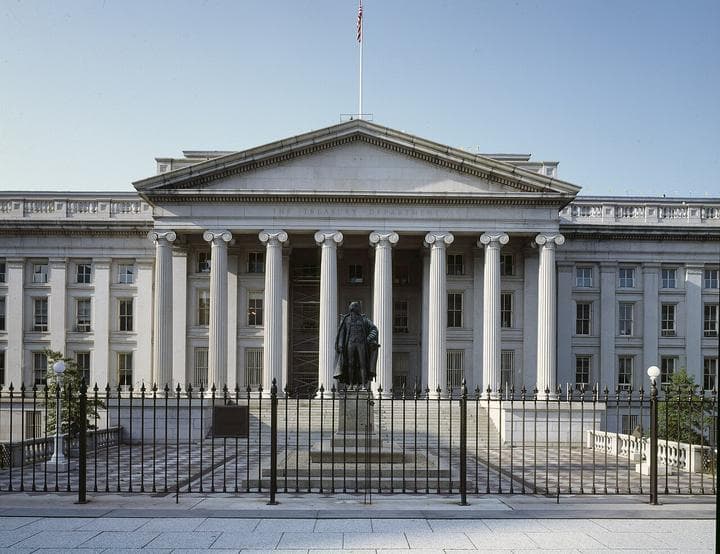
- Cover image: U.S. Treasury Department Building, Library of Congress collection via Wikimedia Commons, public-domain U.S. government image.
- Inline image: "Comptroller of the Currency wall logo Washington DC," photo by G. Edward Johnson via Wikimedia Commons, CC BY attribution.
References
- CSBS Comments on OCC's Reporting Forms and Instructions for Permitted Payment Stablecoin Issuers
- Reporting Forms and Instructions for Permitted Payment Stablecoin Issuers
- Reporting Forms and Instructions for Permitted Payment Stablecoin Issuers
- BPI, ABA File Comment Letter on OCC Reporting Forms for Stablecoin Issuers
- Stablecoin Regulatory Update: GENIUS Act Implementation
- GENIUS Act Signed Into Law: First Federal Stablecoin Framework
Sources (6)
CSBS Comments on OCC's Reporting Forms and Instructions for Permitted Payment Stablecoin Issuers
Conference of State Bank Supervisors
Primary source, published August 11, 2026.
Reporting Forms and Instructions for Permitted Payment Stablecoin Issuers
Office of the Comptroller of the Currency
Primary OCC implementation material.
Reporting Forms and Instructions for Permitted Payment Stablecoin Issuers
Federal Register
Official notice and request for comment.
BPI, ABA File Comment Letter on OCC Reporting Forms for Stablecoin Issuers
Bank Policy Institute
Related banking-industry analysis reviewed for implementation context.
Stablecoin Regulatory Update: GENIUS Act Implementation
Troutman Pepper Locke
Related legal analysis reviewed for regulatory context.
GENIUS Act Signed Into Law: First Federal Stablecoin Framework
Davis Wright Tremaine
Related explainer reviewed for statutory background.
Related reading
Continue exploring FreezeRadar knowledge content.


On this page
Get posts like this by email
A daily or weekly digest of FreezeRadar freeze activity.
By FreezeRadar Team
Research and product team behind FreezeRadar.