Circle's OCC Trust Bank Approval Moves USDC Risk Into a More Formal Control Plane
Circle won final OCC approval for Circle National Trust on July 10, 2026. The important question for wallet-risk teams is how federal trust-bank supervision changes USDC custody, reserve, and monitoring assumptions.
Check a wallet before you act
Run a FreezeRadar scan for issuer-freeze signals, sanctions exposure, counterparty risk, and freezeable asset sensitivity before moving funds.
What happened on July 10
Circle said on July 10, 2026 that the OCC approved the establishment of First National Digital Currency Bank, N.A., which will operate as Circle National Trust. Circle described the approval as a milestone for institutional custody services and said the trust bank will initially provide fiduciary digital-asset custody for Circle and its affiliates. The company also said its approved business plan could allow limited institutional custody services for banks and other regulated financial institutions later, depending on demand.
The reserve point is important but easy to overstate. Circle said management of the USDC reserve is a future capability, not something that automatically changed on the announcement date. That distinction matters for operational teams. A headline that says "bank approval" is not the same as a completed migration of every reserve, custody, reconciliation, and reporting workflow into a new entity.
The market read the approval as a regulatory win. CoinDesk reported that Circle shares rose sharply after the announcement and framed the approval as part of a wider movement by crypto firms toward federal charters and licenses. The Wall Street Journal emphasized that Circle National Trust will operate as a cryptocurrency-focused trust bank and that the approval is intended to strengthen USDC infrastructure. Investor coverage focused on the equity-market reaction, but for FreezeRadar readers the more durable point is not the stock move. It is the institutionalization of the stablecoin issuer's control surface.
Why this is different from a generic custody headline
Custody is often treated as a back-office detail. For stablecoins, it is part of the risk architecture.
A dollar stablecoin like USDC is more than an on-chain token. It is a package of issuer promises, reserve assets, mint and burn processes, bank relationships, smart-contract permissions, compliance controls, redemption terms, and operational procedures. If one of those layers changes, the practical risk profile changes even when the token contract and ticker stay the same.
Circle National Trust brings one layer of that package under direct OCC supervision. National trust banks are not ordinary retail banks. They do not become consumer deposit-taking institutions simply because they have a federal trust charter. Their role is narrower: custody, fiduciary activity, and related trust-bank services. That is why the approval should not be read as USDC becoming a bank account. It is better understood as a formalization of custody and, potentially later, reserve-management infrastructure.
For institutions, that can still be meaningful. A federally supervised trust-bank entity can make due diligence easier to document. It can clarify supervisory expectations. It can give risk committees a more familiar framework for questions about safeguarding, governance, audits, vendor concentration, and recovery planning. But it also concentrates more attention on the issuer's operational controls. When the control plane becomes more formal, failures become more visible.
The FreezeRadar angle: issuer control becomes easier to map, not less important
FreezeRadar tracks freezeable assets because issuer control is a real part of stablecoin risk. USDC is designed to maintain a dollar value, but it is also issued through a framework where compliance obligations can affect addresses, redemption, and transaction workflows. Teams using USDC should understand both sides of that design.
The OCC approval does not weaken Circle's ability or obligation to operate within sanctions and law-enforcement expectations. If anything, a federally supervised trust-bank structure makes it more important to understand where issuer, custodian, reserve, and compliance responsibilities sit. A wallet that touches sanctioned exposure, a compromised exchange account, or a counterparty under investigation can still become operationally sensitive even if the reserve custody framework is stronger.
That is why this story connects directly to FreezeRadar's coverage of stablecoin compliance, USDC blacklist checks, and the earlier analysis of BNY, Circle, and USDC mint/burn risk. The theme is consistent: institutionalization does not remove freeze risk. It changes the procedures, documentation, escalation points, and counterparties that determine how that risk is handled.
Treasury teams should separate reserve confidence from wallet confidence
A common mistake is to treat better reserve governance as a blanket answer to all stablecoin risk. Reserve confidence and wallet confidence are related, but they are not the same.
Reserve confidence asks whether the tokens are backed, whether assets are safeguarded, whether reporting is reliable, and whether redemption mechanics are credible. Wallet confidence asks whether the specific wallet or counterparty is safe to receive from, pay to, custody for, or route through. The first is issuer-level. The second is address-level.
Circle's trust-bank approval may help the first category over time, particularly if reserve-management capabilities move under OCC-supervised infrastructure. It does not answer the second category. A treasury desk still needs to know whether the sending wallet has sanctions proximity, mixer exposure, exchange-intervention risk, stolen-funds exposure, or links to issuer blacklist activity. A payment operations team still needs to decide whether to accept a transfer, hold it for review, request source-of-funds documentation, or route it through a different account.
That split should shape policy. USDC can be a preferred settlement asset for some teams and still require pre-transfer screening. A federally supervised custody layer can strengthen the issuer's institutional profile and still leave individual wallets exposed to address-level risk. Treating those as one question is how teams end up surprised.
What monitoring should change now
The immediate operational change is not that every USDC workflow must be rewritten. The better response is to update the monitoring map.
First, treasury and compliance teams should document which Circle entity performs which role in their own flows. If an organization uses Circle Mint, an exchange custody account, a prime broker, or a third-party payment processor, it should distinguish issuer exposure from platform exposure. Circle National Trust may become relevant to some of those flows, but not all of them at the same time.
Second, teams should add "issuer infrastructure change" as a monitoring event. Stablecoin risk programs often monitor sanctions updates, chain incidents, depegs, bridge exploits, and exchange freezes. They should also monitor charter approvals, reserve custodian changes, trust-bank openings, policy updates, token-contract changes, and terms-of-service revisions. Those changes can alter escalation routes and evidence requirements even when they do not move the market price.
Third, wallet-risk rules should remain address-specific. A stronger issuer control environment can make enforcement more credible. It does not make every USDC wallet lower risk. In some cases, clearer institutional controls can mean faster intervention once a wallet is identified as problematic. That is useful for victims and regulated counterparties, but it is also a reason to keep provenance checks current.
The sanctions and counterparty implications
The OCC approval lands in a broader policy environment where stablecoin issuers are expected to behave more like financial institutions. Treasury's 2026 stablecoin rulemaking and the wider GENIUS Act framework pushed issuers toward AML and sanctions compliance obligations. Circle's trust-bank approval is a separate chartering event, but the direction is aligned: stablecoin infrastructure is moving further into regulated finance.
For sanctions teams, this means the line between on-chain monitoring and traditional compliance is getting thinner. A wallet-risk alert can affect a redemption decision. A sanctions update can affect an exchange account. A law-enforcement request can affect a token balance. A custodian or trust-bank control can affect how quickly evidence is preserved or funds are segregated.
Counterparty reviews should reflect that. Asking whether a partner supports USDC is not enough. Teams should ask which USDC rails the partner uses, whether funds touch omnibus wallets, what screening provider is used, how often addresses are rescored, whether the partner can supply transaction-level evidence, and how it handles issuer intervention events. In a more formal control plane, weak documentation stands out faster.
What to watch next
The next practical milestone is the opening and operating scope of Circle National Trust. Circle said the bank will offer fiduciary digital-asset custody services for Circle and affiliates upon opening, while reserve management is planned as a future capability. Teams should watch for any announcement that reserve operations, custody arrangements, or institutional client services have moved into the trust bank.
The second milestone is regulatory comparison. Circle is not alone. The OCC's December 2025 conditional approvals also named other digital-asset trust-bank applicants, including Ripple, BitGo, Fidelity Digital Assets, and Paxos. If multiple issuers and custodians move into national trust-bank structures, stablecoin risk analysis will need to compare supervisory models, reserve custody designs, and intervention procedures across issuers rather than treating "regulated" as a single label.
The third milestone is incident behavior. The real test of a control plane is not the approval ceremony. It is what happens during a stressed redemption day, a sanctions designation, a major exchange freeze, a compromised institutional wallet, or a chain-specific disruption. Teams should track whether USDC holds its peg, and how quickly counterparties communicate, how clearly evidence is requested, and whether intervention decisions are explainable after the fact.
Key takeaway
Circle's final OCC approval is a meaningful institutional step for USDC, but it should not be read as a reason to relax wallet-level monitoring. It is a reason to make monitoring more precise.
The strongest stablecoin programs will now separate issuer-level confidence from address-level confidence. They will understand where reserve custody, fiduciary custody, mint/burn operations, blacklist controls, and sanctions escalation sit. They will not assume that a federally supervised trust-bank layer makes every incoming wallet safe. And they will treat issuer infrastructure changes as part of the same operational risk map as sanctions updates, freeze events, and counterparty interventions.
For FreezeRadar, that is the core lesson: as stablecoins move deeper into regulated finance, wallet risk does not disappear. It becomes more accountable, more procedural, and more important to document before funds move.
Image credits and licenses
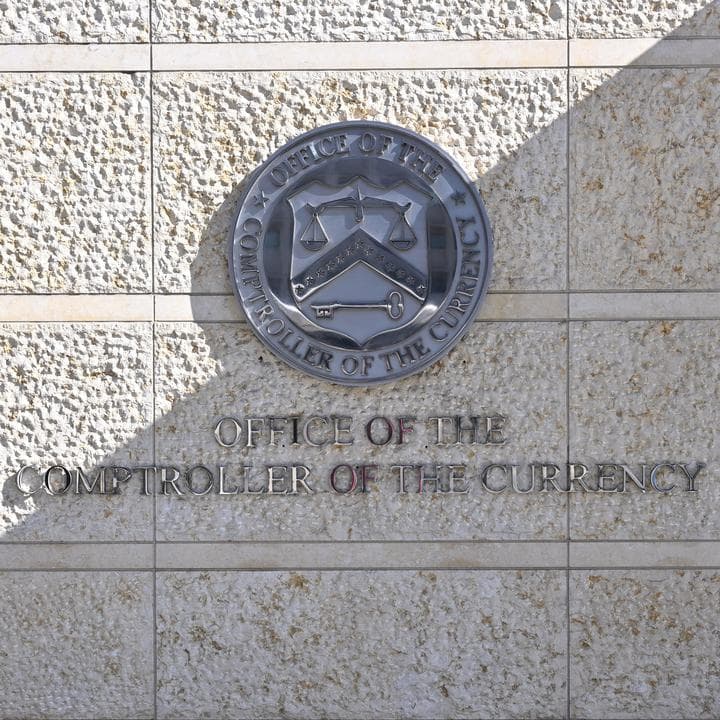
Cover image: Office of the Comptroller of the Currency wall logo at 400 7th Street SW, Washington, DC, photographed by G. Edward Johnson and made available on Wikimedia Commons under CC BY 4.0. Inline image: U.S. dollar currency photograph by MarkBuckawicki, made available on Wikimedia Commons under CC0 1.0 public domain dedication.
References
- Circle Receives Final OCC Approval to Establish National Trust Bank
- Digital Assets Licensing Applications
- Circle soars after securing U.S. trust bank approval in crypto expansion
- Circle is granted a trust bank charter from the OCC
- Circle Receives Approval to Launch Crypto-Focused Bank
- Circle Stock Rallies On National Bank Approval. ARK Buys More Shares.
Sources (6)
Circle Receives Final OCC Approval to Establish National Trust Bank
Circle
Primary source, published July 10, 2026; confirms final OCC approval, trust-bank name, custody scope, and future reserve-management capability.
Digital Assets Licensing Applications
Office of the Comptroller of the Currency
Regulator context for digital-asset national trust bank applications.
Circle soars after securing U.S. trust bank approval in crypto expansion
CoinDesk
Related article reviewed for market reaction, custody scope, and federal oversight context; published July 10, 2026.
Circle is granted a trust bank charter from the OCC
American Banker
Related banking-sector analysis reviewed for charter-opening and trust-bank framing.
Circle Receives Approval to Launch Crypto-Focused Bank
The Wall Street Journal
Related article reviewed for mainstream finance framing and institutional custody emphasis; published July 2026.
Circle Stock Rallies On National Bank Approval. ARK Buys More Shares.
Investor's Business Daily
Related article reviewed for equity-market reaction and announcement timing; updated July 10, 2026.
Related reading
Continue exploring FreezeRadar knowledge content.


On this page
Get posts like this by email
A daily or weekly digest of FreezeRadar freeze activity.
By FreezeRadar Team
Research and product team behind FreezeRadar.