TRC-20 vs ERC-20 USDT Freeze Mechanics for Wallet Desks
Tron and Ethereum USDT freezes are per-contract lists, not one synced flag. Two-rail checklist for OTC and treasury teams that settle on both networks.
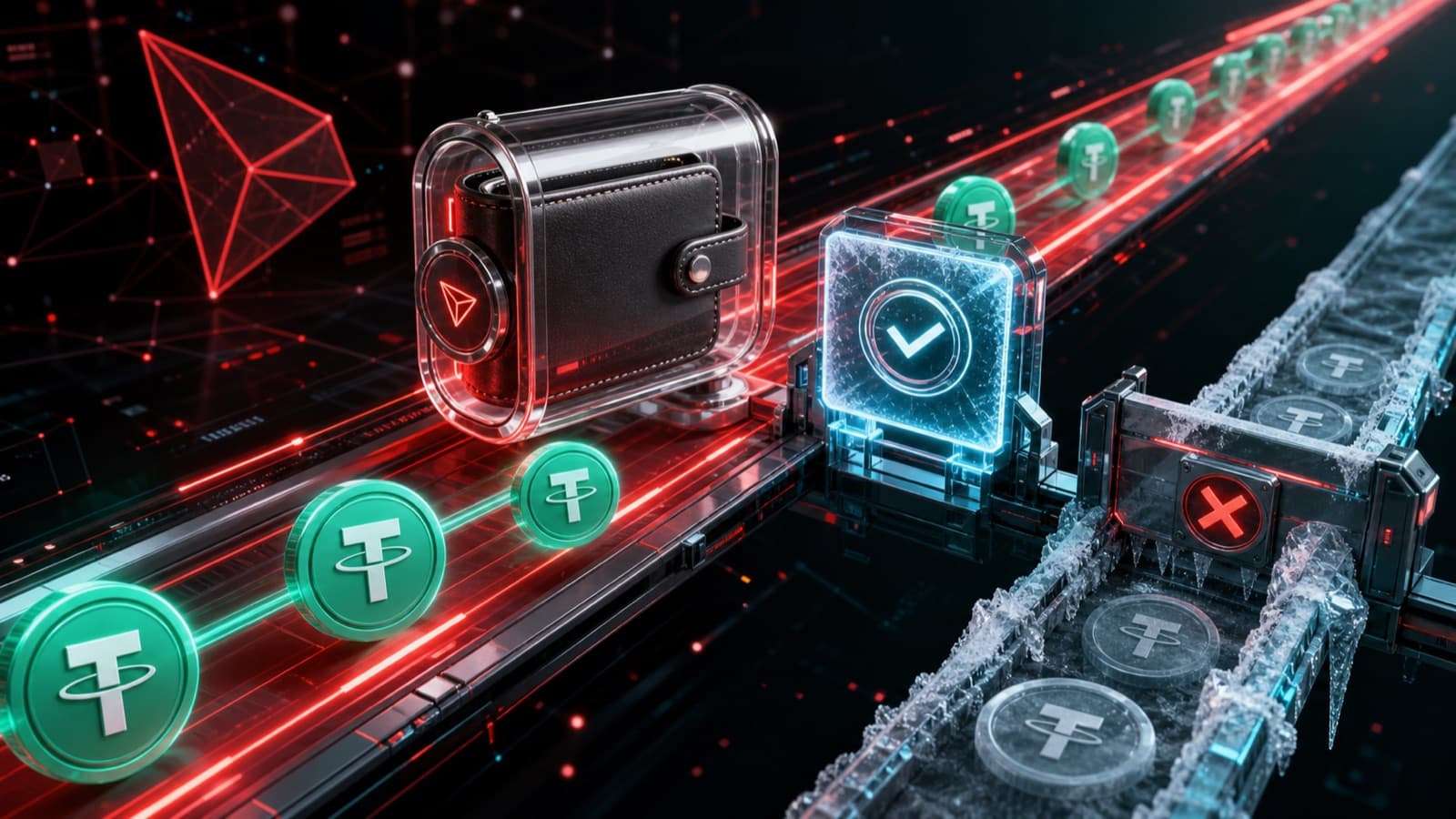
USDT freeze risk is per contract and per chain. TRC-20 on Tron and ERC-20 on Ethereum share an issuer brand and a blacklist concept, but they do not share one synchronized list, one explorer, or one deposit address format. Desks that screen “the USDT wallet” once and assume both rails are covered create false negatives every week.
This is the mechanics comparison for wallet ops: what is common, what diverges, and how to run a two-rail checklist without overclaiming. Educational—not legal advice.
Check a wallet before you act
Run a FreezeRadar scan for issuer-freeze signals, sanctions exposure, counterparty risk, and freezeable asset sensitivity before moving funds.
Same issuer idea, different settlement surfaces
Tether’s Token Terms allow issuance across multiple protocols and warn that wrapped or bridged lookalikes are not redeemable Tether Tokens. Operationally:
- Ethereum ERC-20 USDT — official contract
0xdAC17F958D2ee523a2206206994597C13D831ec7. Classic surface includesaddBlackList,removeBlackList,destroyBlackFunds, and public blacklist reads (isBlackListed/getBlackListStatus). - Tron TRC-20 USDT — official contract
TR7NHqjeKQxGTCi8q8ZY4pL8otSzgjLj6t. Privileged freeze/blacklist behavior exists on that contract’s control plane; you verify it on Tron explorers / Tronscan-style read tools, not on Etherscan.
A clear or a flag on one rail does not mutate the other. Treasury policies that say “USDT is frozen” without naming the chain are incomplete tickets.
Thin landings for product CTAs: TRC-20 frozen wallet check, ERC-20 USDT freeze check, Tether blacklist check. Contract-authority depth: Can Tether freeze USDT?.
Where desks actually feel the difference
Volume and speed. Much OTC and P2P USDT still clears on Tron because fees and settlement speed favor it. That concentration means Tron freezes show up first in many “send failed” queues—including ban-wave weeks documented in USDT ban wave Tron August 2026.
Address formats. Base58 Tron vs hex Ethereum. Paste errors create “we screened it” tickets that screened nothing. Force chain selection in your intake form before any analyst runs a tool.
Explorer literacy. Analysts need both Etherscan-class and Tronscan-class muscle memory for event names, failed transfers, and read-contract tabs. The click-path primer is read contract directly.
Gas assets. A Tron USDT freeze does not freeze TRX. An Ethereum USDT freeze does not freeze ETH. Clients often conflate “wallet dead” with “USDT blocked.” Train the distinction.
Exchange deposit addresses. Venues issue per-asset deposit addresses. A blacklist on a user’s personal Tron wallet is not the same object as an omnibus hot wallet the exchange controls. Venue holds remain a separate plane—exchange hold vs issuer blacklist.

Two-rail pre-accept checklist
- Ask the counterparty which rail they will settle on. Do not accept “USDT” alone.
- Collect the exact sending address in the correct format.
- Read blacklist status on that contract.
- Screen sanctions/labels/counterparties separately (OFAC wallet screening check).
- If dual-rail treasury exists, screen the receiving address on both deployments you actually use.
- Save explorer URLs + a FreezeRadar scan with chain context.
- If the ticket is post-failure, confirm whether the failed tx was TRC-20 or ERC-20 before opening an issuer case.
Bridged and “USDT-looking” tokens
Bridges and wrapped representations create a third failure mode: the UI ticker says USDT, the contract is not Tether’s official issuance, and the risk model (including freeze authority) belongs to someone else—or to a bridge multisig. FreezeRadar’s discipline is to name the registered asset and chain. If your desk cannot identify the contract, pause settlement.
Ban waves and monitoring
Issuer freeze clusters often appear first on the high-volume rail. Monitoring that only indexes Ethereum AddedBlackList events will under-detect Tron-heavy weeks. Split alerts by chain. Playbook depth: how a USDT ban wave looks.
Destroy vs freeze remains per contract too—freeze vs destroyBlackFunds.
Honest limits
ABI labels and explorer UIs change. Always verify you are on the official contract page. Provider coverage in any scanner can differ by chain; a missing signal is not a clearance. This article does not help move value around a freeze or choose rails to evade controls.
Settlement script for OTC desks
Before price lock:
- “Confirm network: Tron TRC-20 or Ethereum ERC-20.”
- “Send a screenshot of the sending address from the wallet, not a typed paste alone.”
- “We will screen that exact address on that network’s official USDT contract.”
After a failed send:
- “Did the wallet show a failed USDT transfer, or did an exchange UI block withdrawal?”
- “Paste the transaction hash if any broadcast occurred.”
- “We will re-read blacklist status on the network you used—not the other one.”
These scripts sound basic. They eliminate the weekly class of tickets where Ethereum was screened and Tron was settled.
Dual-treasury architecture notes
If you maintain both rails:
- Separate receiving addresses per chain.
- Separate investigation wallets per chain.
- Never sweep “all USDT” with a tool that silently picks a default network.
- Reconcile finance line items with chain tags (
USDT-TRC20,USDT-ERC20). - Alerting: two freeze detectors, not one.
Contagion still happens when a counterparty pays you on Tron from a cluster that also touches Ethereum. That is counterparty graph risk, not list sync. Use multi-hop discipline from tainted USDT multi-hop without overclaim and patterns.
Fee markets and false confidence
Low Tron fees increase pass-through broker behavior: funds hop quickly across many addresses. High Ethereum fees can suppress hop count but do not reduce issuer authority. Neither fee market is a safety signal. Screen history and counterparties regardless of gas cost.
Exchange omnibus confusion
CEX deposit addresses are often shared or rotated under venue control. A user’s personal self-custody Tron address being blacklisted does not automatically blacklist the exchange’s deposit address—and the reverse is also true. When a customer says “Binance/OKX/… froze my USDT,” run the exchange hold vs issuer triage before you open a Tether case naming the wrong address.
Worked mini-case
Counterparty agrees to pay 250k USDT “on USDT.” They send on Tron. Your intake form defaulted to Ethereum and screened an old ETH address they used months ago (clean). Tron sending address had recent high-risk hops. Payment lands, later faces review. Root cause: rail mismatch in screening, not “USDT is fine.” Fix: chain-required fields + before CEX/OTC screen workflow habits adapted to OTC.
Related FreezeRadar surfaces
Monitoring metrics that actually help
Track weekly:
- Count of failed customer sends by chain
- Count of issuer blacklist hits detected on Tron vs Ethereum
- Count of tickets mis-tagged as issuer freeze that were venue holds
- Mean time from failed send → correct-chain blacklist read
If Tron failures dominate but Ethereum screens dominate analyst time, your staffing model is inverted relative to settlement reality.
When USDC enters the same conversation
Counterparties sometimes offer to “just pay USDC on Ethereum instead” after a Tron USDT scare. That can be a rational rail change, but it is a different issuer control plane (Circle), not a magic shield. Point them at USDT vs USDC freeze risk and still screen the new sending wallet. Do not treat asset switching as a substitute for counterparty diligence.
Documentation for auditors
Auditors and enterprise clients increasingly ask how you handle multi-chain stablecoins. A one-page annex that cites official contract addresses, your screening order (chain → blacklist read → sanctions/labels → composite scan), and your freeze-vs-destroy definitions will save repeated meetings. Link this blog and can Tether freeze USDT as the narrative layer behind the SOP.
Analyst cheat sheet (print and tape)
- Tron address starts with
T(typical). Ethereum with0x. - Official USDT Ethereum:
0xdAC17F958D2ee523a2206206994597C13D831ec7. - Official USDT Tron:
TR7NHqjeKQxGTCi8q8ZY4pL8otSzgjLj6t. - Always write
USDT-TRC20orUSDT-ERC20in tickets. - Failed send + blacklist false ⇒ think venue or wrong asset.
- Blacklist true + balance > 0 ⇒ freeze-only until destroy proven.
- Save explorer URL + scan URL every time.
Why “one USDT balance” accounting fails
Corporate treasuries often show a single USDT figure in a spreadsheet. Underneath may sit Tron hot wallets, Ethereum custody, and exchange balances. Issuer freezes hit contract balances; venue freezes hit account ledgers; accounting that ignores the split will misstate liquidity during a ban-wave week. Tag every balance by venue-or-self-custody and by chain. When Tron freezes spike, you should be able to answer in minutes how much USDT-TRC20 self-custody is exposed versus how much sits in venue ledgers that may still be transferable under different rules.
Key takeaway
TRC-20 and ERC-20 USDT freezes are sibling controls, not one shared list. Name the chain, read the matching contract, and document both when treasury spans rails. Start with a chain-aware scan, then escalate with hashes—not with a single ambiguous “USDT frozen” subject line.
Sources (5)
Ethereum USDT token (read contract)
Etherscan
Official ERC-20 USDT blacklist reads.
Tether Token Terms of Sale and Service
Tether
Multi-protocol issuance and lookalike warnings.
TRC20 Frozen Wallet Check
FreezeRadar
Thin landing for Tron USDT checks.
ERC20 USDT Freeze Check
FreezeRadar
Thin landing for Ethereum USDT checks.
USDT Ban Wave on Tron (August 2026)
FreezeRadar
Event context for Tron-heavy freeze clusters.
Related reading
Continue exploring FreezeRadar knowledge content.

On this page
Get posts like this by email
A daily or weekly digest of FreezeRadar freeze activity.
By FreezeRadar Team
Wallet risk intelligence and stablecoin compliance analysis from FreezeRadar.